

Documentation Index
Fetch the complete documentation index at: https://domoinc-arun-raj-connectors-domo-479695-remove-crime-report.mintlify.app/llms.txt
Use this file to discover all available pages before exploring further.
Intro
The System for Cross-domain Identity Management (SCIM) is a standard that defines API endpoints that systems can use to manage identity. With an SSO integration, Domo receives information about new or updated users only when they log into Domo. However, with SCIM, you can configure your identity provider (IdP) to create and/or update users and groups in Domo when those users and groups are created and modified in your IdP.Note: To learn more about SCIM, see the IETF protocol document  .
.
.Prerequisites
Domo’s SCIM endpoints use header-based authorization with a Domo access token. Domo’s SCIM endpoints accept either of the two authorization headers, both of which require access tokens:- Authorization: Bearer < Domo Access Token >
- X-Domo-Developer-Token: < Domo Access Token >
Configure Required Grants
We recommend that you create a SCIM Integration custom role and user:- Create a “SCIM Integration Role” as a custom role in your Domo instance — This role can be assigned only the grants required to support your intended usage of the SCIM integration (see required grants below). Learn how to create and define custom roles.
- Create a “SCIM Integration User” in your Domo instance and assign it to the SCIM Integration Role — Domo’s SCIM endpoints require authorization using a Domo access token, and access tokens are associated with specific Domo users. Taking this approach, the access token used in the SCIM integration can be assigned to the SCIM Integration User.
- Manage All Users — This grant allows the holder to create, edit, and delete any user and reset their password.
- Manage All Roles — This grant allows the holder to create, edit, and delete custom roles and assign any role to any user.
-
Manage All Groups — This grant allows the holder to manage group settings, modify Ad Hoc Domo groups, and create and manage Directory groups via SCIM.
Note: This grant is not required if you don’t intend to use the SCIM Groups endpoints or the group-related attributes in the SCIM Users endpoint.Note: These are all admin-level grants, included automatically with the Admin system role, and allow you to add and manage all aspects of users, including setting roles and changing passwords.
Synchronize Directory Groups
Domo directory groups (groups defined in the IdP and created and managed in Domo via SSO or SCIM integration) can be created, managed, and deleted via SSO and SCIM. The SCIM APIs only function on directory groups. This means that groups created via SCIM are always directory groups, and the Get Group endpoint only returns information about directory groups. Learn more about directory groups and other group types in Domo. Domo’s SCIM integration functions in the context of the Domo user who owns the Domo Access Token used by the SCIM integration. (See our recommendations for the SCIM Integration User above.) To allow Domo directory groups to be managed via SCIM, the Domo SCIM Integration User must be designated in Groups Settings as the user permitted to manage directory groups. Follow these steps to designate the SCIM Integration User in Group Settings:- Go to Admin > Governance > Groups.
-
Select
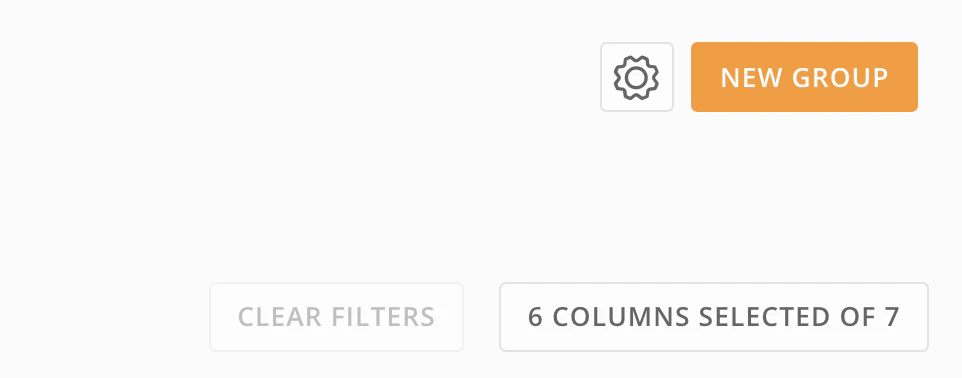
 Group Settings (gear icon).
-
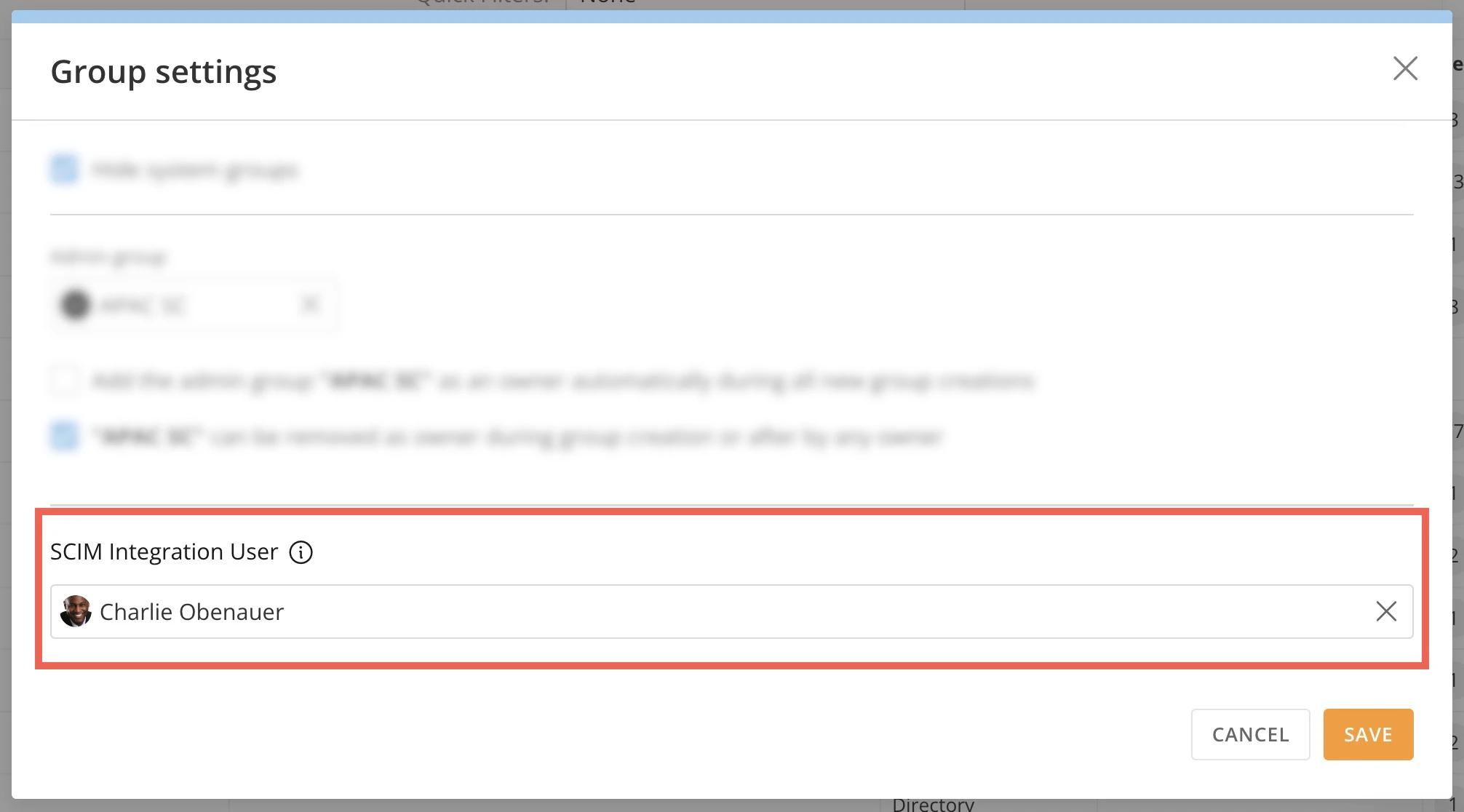
In the modal that displays, use the dropdown to choose the SCIM Integration User and save your changes.
Review Supported Endpoints
Domo’s SCIM implementation supports many standard endpoints. The endpoint information provided in the sections below is to help you configure your IdP. For details of what is required with each action, refer to the SCIM spec .
Endpoint root:
.
Endpoint root:
Configure Schemas
The following configuration and schema endpoints are supported in Domo:| Endpoint Name | Description | Endpoint |
|---|---|---|
| Get Service Provider Configuration | Retrieves the SCIM features and functionality supported by Domo. | GET /ServiceProviderConfig |
| Get Schemas | Retrieves a detailed list of supported SCIM schemas. | GET /Schemas |
| Get User Schemas | Retrieves the user schemas. | GET /Schemas/User |
Manage Users
The following user endpoints are supported in Domo:| Endpoint Name | Description | Endpoint |
|---|---|---|
| Get Users | Retrieves all users with different request parameters to filter users. The following request and filter parameters are supported: Filter, requestedAttributes (comma-separated list of strings), startIndex (offset), count (limit), sortBy (choose a user attribute to sort by), sortOrder (ascending or descending) | GET /Users |
| Get User | Retrieves a user specified by their Domo userId. The requested attributes can be passed in as a comma-separated list via query parameters named “attributes.” Note that some attributes are always returned. | GET /Users/{userId}Examples: Returns a user with the phoneNumber attribute: /Users/{userId}?attributes=phoneNumbersReturns a user with all Domo attributes, including custom attributes: /scim/Users/{userId}?attributes=_all |
| Put User | Updates a user by Domo userId. The user’s existing attributes will be completely replaced by the attributes specified in the PUT request. If you need to update partially existing users, use the PATCH user endpoint. | PUT /Users/{userId} |
| Patch User Beta | Partially updates a user’s attributes as specified in the request body. Most user attributes can be added, replaced, or removed. | PATCH /Users/{userID} |
| Delete User | Deletes the specified Domo user. | DELETE /Users/{userId} |
| Post User | Creates a user in Domo. | POST /Users |
Examples
POST /Users
PUT /Users/{USER_ID}
This deletes a user via PUT
PATCH /Users/{USER_ID}
Manage Groups
The following group endpoints are supported in Domo:| Endpoint Name | Description | Endpoint |
|---|---|---|
| Get Group | Get a group by ID. | GET /Groups/{groupID} |
| Post Group | Create a group in Domo. | POST /Groups |
| Put Group | Update a group—group definition in Domo is completely replaced by the new group definition. | PUT /Groups/{groupId} |
| Patch Group | Partially updates a group’s attributes. Note: Unlike PATCH for users, PATCH for groups supports only the following operation structure: { "op": "Replace|Add|Remove", "path": "attributePath", "value": value }. “path” is always required and its value is case-sensitive. Removing group attributes is not supported, except for members. The “value” for the members path must be an array of objects each containing a “value” property with the Domo user ID (for example, [{"value": 84173534}]). The $ref attribute is ignored. | PATCH /Groups/{groupID} |
| Delete Group | Delete a group. | DELETE /Groups/{groupID} |
Examples
POST /Groups
Configure Your IdP
The SCIM integration between your IdP and Domo is configured on the IdP side. To get started, refer to the documentation from your IdP.Map Schemas and Attributes
During configuration, you must configure which user attributes and group properties are synchronized to Domo from your IdP. Domo’s SCIM endpoints map elements from six SCIM schemas. These schemas and their elements are mapped to various Domo user and group attributes. The tables below list the Domo user and group attribute names and the corresponding SCIM schema and attribute.Map User Attributes
| Domo Attribute | Schema | SCIM Element | Notes |
|---|---|---|---|
| User Name (Required) This is the user’s email address, which is the unique identifier for the user in Domo. | urn:ietf:params:scim:schemas:core:2.0:User | userName | |
| Name | urn:ietf:params:scim:schemas:core:2.0:User | displayName | Domo uses displayName for the user’s name. The “name” complex attribute (givenName, familyName, etc.) is not supported and will be ignored. |
| Email (Required) | urn:ietf:params:scim:schemas:core:2.0:User | emailsAn array of complex of email and type. Type of “work” maps to Domo user primary email address. | For Okta: specify the external name as emails.^[primary == true].typeFor Entra: specify emails[type eq "work"].value |
| Alternate email | urn:ietf:params:scim:schemas:core:2.0:User | emailsAn array of complex of email and type. Type of “alternate” maps to Domo user alternate email address. | For Okta: specify the external name as emails.^[primary == false].typeFor Entra: specify emails[type eq "alternate"].value |
| Active Indicates whether the user is active in Domo. | urn:ietf:params:scim:schemas:core:2.0:User | active | |
| Role Domo supports a single role per user. Role is optional on both create (POST) and update (PUT). | urn:ietf:params:scim:schemas:core:2.0:User | roles- Single-valued array of complex of role id (required) and role name (optional; ignored by Domo). - Domo accepts only one role per user, so the roles array must contain only a single value. | For Okta: specify roles.^[primary == true].id |
| Employee ID | urn:ietf:params:scim:schemas:extension:enterprise:2.0:User | employeeNumber | |
| Hire date | urn:ietf:params:scim:schemas:extension:domo:2.0:User | hireDate | Domo stores this field as a date. If your IdP sends a date-time value, Domo will accept and convert it, but the type mismatch may cause your IdP to evaluate the field as changed and re-send it on every sync. To prevent this, convert the field to a date type in your source system before mapping it. |
| Title | urn:ietf:params:scim:schemas:core:2.0:User | title | |
| Department | urn:ietf:params:scim:schemas:extension:enterprise:2.0:User | department | |
| Location | urn:ietf:params:scim:schemas:extension:domo:2.0:User | employeeLocation | |
| Mobile phone | urn:ietf:params:scim:schemas:core:2.0:User | phoneNumbersArray of complex of phone number and type. Type of “mobile” maps to Domo user mobile phone number. | |
| Desk phone | urn:ietf:params:scim:schemas:core:2.0:User | phoneNumbersArray of complex of phone number and type. Type of “work” maps to Domo user desk phone number. | |
| Locale | urn:ietf:params:scim:schemas:core:2.0:User | locale | |
| Timezone | urn:ietf:params:scim:schemas:core:2.0:User | timezone | |
| Group | urn:ietf:params:scim:schemas:core:2.0:User | groups / {value, display}Where value is the ID of the group in Domo and display is the group name as defined in the IdP. | |
| Organization | urn:ietf:params:scim:schemas:extension:enterprise:2.0:User | organization | |
| Manager | urn:ietf:params:scim:schemas:extension:enterprise:2.0:User | manager {value, display}Complex of value (Domo user ID) and display (optional, manager name, ignored by Domo). | |
| All custom attributes | urn:ietf:params:scim:schemas:extension:custom:2.0:User | customAttributes [{key, values}]Array of complex of key (the attribute key as defined in Domo) and values (the user attribute values). Values must be provided as a list of strings, regardless of the data type of the attribute or whether the attribute is single-valued or a list. | Custom attributes must be defined in Domo before they can be populated via SCIM, and the key in the SCIM must match the attribute key in Domo exactly (case-sensitive). |
Map Group Attributes
| Domo Attribute | Schema | SCIM Attribute | Notes |
|---|---|---|---|
| Directory Name The group name as defined in the IdP. | urn:ietf:params:scim:schemas:core:2.0:Group | displayName | |
| Domo Group Display Name The group name in Domo that is most readily accessible to Domo users and is presented to users throughout the product, such as when sharing content or viewing card ownership. | urn:ietf:params:scim:schemas:extension:domo:2.0:Group | domoDisplayName | |
| Description | urn:ietf:params:scim:schemas:extension:domo:2.0:Group | description | |
| Group Membership | urn:ietf:params:scim:schemas:core:2.0:Group | membersAn array of complex of value (the group member Domo user ID) and display (optional, group member name, ignored by Domo). |